- Song Introduction
- Lyrics: A Narrative of Conflict
- Lyrics Meaning: Layers of Protest
- Musical Composition
- Cultural Context and Reception
- Conclusion: Why This Song Matters
Song Introduction
In late January 2026, Bruce Springsteen released "Streets of Minneapolis," a digital-only protest single that immediately topped iTunes charts. The song serves as a direct musical response to the fatal shootings and subsequent civil unrest in Minneapolis that month, involving agents from Immigration and Customs Enforcement (ICE) and Customs and Border Protection (CBP). Springsteen described his motivation as addressing "the state terror that descended upon Minneapolis" while honoring both the victims and immigrant communities caught in the conflict.
This release continues Springsteen's decades-long tradition of crafting socially conscious narratives set against American backdrops. The track's title deliberately echoes his 1993 Oscar-winning "Streets of Philadelphia," while its urgent political commentary recalls earlier protest works like "American Skin (41 Shots)." Produced in collaboration with Ron Aniello and featuring backing vocals from Patti Scialfa, the song builds from spare acoustic guitar and vocals to a full-band arrangement punctuated by Springsteen's signature harmonica breaks—a musical progression that mirrors its escalating emotional intensity.
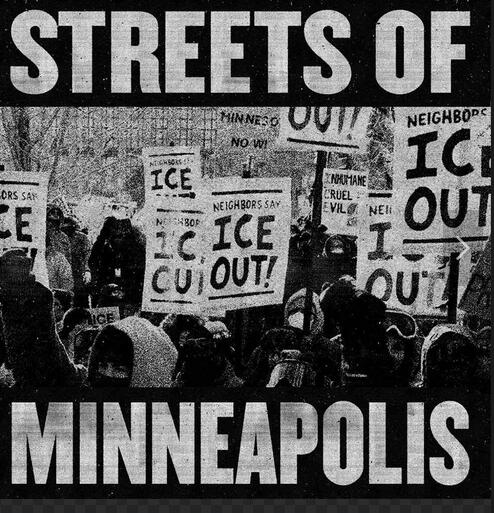
Lyrics: A Narrative of Conflict
Through the winter's ice and cold
Down Nicollet Avenue
A city aflame fought fire and ice
'Neath an occupier's boots
King Trump's private army from the DHS
Guns belted to their coats
Came to Minneapolis to enforce the law
Or so their story goes
Against smoke and rubber bullets
In the dawn's early light
Citizens stood for justice
Their voices ringing through the night
And there were bloody footprints
Where mercy should have stood
And two dead, left to die on snow-filled streets
Alex Pretti and Renee Good
Oh, our Minneapolis, I hear your voice
Singing through the bloody mist
We'll take our stand for this land
And the stranger in our midst
Here in our home, they killed and roamed
In the winter of '26
We'll remember the names of those who died
On the streets of Minneapolis
Trump's federal thugs beat up on
His face and his chest
Then we heard the gunshots
And Alex Pretti lay in the snow dead
Their claim was self-defense, sir
Just don't believe your eyes
It's our blood and bones
And these whistles and phones
Against Miller and Noem's dirty lies
Oh, our Minneapolis, I hear your voice
Crying through the bloody mist
We'll remember the names of those who died
On the streets of Minneapolis
Now they say they're here to uphold the law
But they trample on our rights
If your skin is black or brown, my friend
You can be questioned or deported on sight
In our chants of "ICE out now"
Our city's heart and soul persists
Through broken glass and bloody tears
On the streets of Minneapolis
Oh, our Minneapolis, I hear your voice
Singing through the bloody mist
Here in our home, they killed and roamed
In the winter of '26
We'll take our stand for this land
And the stranger in our midst
We'll remember the names of those who died
On the streets of Minneapolis
We'll remember the names of those who died
On the streets of Minneapolis
ICE out (ICE out)
ICE out (ICE out)
ICE out (ICE out)
ICE out (ICE out)
ICE out (ICE out)
ICE out
Lyrics Meaning: Layers of Protest
Beyond documenting events, the lyrics operate on three distinct interpretive levels:
1. Immediate Reportage
The song functions as musical journalism, chronicling the Minneapolis confrontation with specific details that news reports often generalize. References to "rubber bullets," "whistles and phones," and "broken glass" create documentary authenticity. By naming policy architects Stephen Miller and Kristi Noem alongside the victims, Springsteen creates what cultural critic Simon Frith might call "an accountability ledger in verse."
2. Systemic Critique
The second layer attacks systemic injustice, particularly regarding immigration and racial discrimination:
If your skin is black or brown, my friend
You can be questioned or deported on sight
These lines contextualize isolated incidents within broader patterns of institutional discrimination, challenging the official "enforcing the law" narrative by highlighting its disproportionate impact on communities of color.
3. Redefining Patriotism
The most subtle layer reimagines civic belonging. The line "We'll take our stand for this land/And the stranger in our midst" presents an inclusive vision of patriotism that directly counters the exclusionary rhetoric dominating immigration debates. This framing transforms the protest from mere opposition into an affirmative declaration of values.
Musical Composition
Musically, "Streets of Minneapolis" follows the folk-rock protest tradition while incorporating contemporary urgency. The arrangement builds deliberately:
-
Introduction: Solo acoustic guitar and vocals establish intimacy and gravity
-
First chorus: Light percussion and harmonica enter, suggesting gathering momentum
-
Second verse: Bass and organ textures deepen the musical landscape
-
Bridge ("Now they say they're here to uphold the law..."): Full band instrumentation creates tension
-
Final choruses: Layered vocals and driving rhythm section evoke collective action
-
Outro: The repeated "ICE out" chant over fading instrumentation suggests ongoing struggle
This dynamic progression mirrors the transformation of individual outrage into collective movement, a musical metaphor for civic mobilization.
Cultural Context and Reception
The song emerged within the highly polarized climate of early 2026, marking another chapter in Springsteen's long-standing criticism of Donald Trump, who had previously dismissed him as a "washed-up rock star." White House Press Secretary Karine Jean-Pierre responded dismissively, stating the administration remained "focused on having federal law enforcement remove dangerous illegal foreign criminals from our communities rather than random songs with irrelevant opinions and inaccurate information."
Despite—or perhaps because of—official dismissal, the song resonated powerfully. Its rapid ascent on download charts demonstrated that Springsteen retains his unique capacity to articulate civic anguish, transforming current events into what scholar George Lipsitz might term "the historical present." The song continues the important American tradition of protest music while asking pressing questions about state power, memory, and who truly belongs in the American story.
Conclusion: Why This Song Matters
"Streets of Minneapolis" represents more than musical commentary—it's cultural documentation that will likely outlast news cycles. By memorializing Alex Pretti and Renee Good alongside condemnation of systemic injustice, Springsteen performs what philosopher Jacques Derrida might call an "act of impossible mourning," acknowledging loss while demanding change. The song's power derives not from offering solutions but from its unyielding witness—refusing to let certain lives be forgotten or certain actions be normalized.
In an era of fragmented media and contested narratives, Springsteen uses the unifying potential of music to create what Benedict Anderson termed an "imagined community" of conscience. The song ultimately suggests that how we remember events—whose stories we preserve, whose names we repeat—determines not just our understanding of the past, but our possibilities for the future.
